Well, here we are, in our new house, in our new city, in our new lives.
Been here since Monday, in fact. I brought up the rear of the caravan, providing transportation for (among many other things) our two cats. (Any of you who have ever traveled with cats know what that was like.)
I've had my handyman hat on since my arrival -- which so far mostly means that I've been doing a lot of painting.
The week before the move was fairly stressful. Played the last IJG gig of '06 at Safari Sam's on Thursday -- and it was sort of an anticlimax after the fun we had on our August tour. The band played well enough, though we were (in my opinion) seriously crippled by an unusually large number of subs. Further, the LA audience, which had come out in full force for our previous show (at Club Tropical), had seemingly retreated back into the warm comfort of a living room, a TV, and a beer. In other words, hardly anyone came out to hear us. All of this is quite frustrating, given that Safari Sam's is one of the coolest spaces we've ever had the opportunity to play.
Aside from the gig, pre-PDX week was full of recording sessions, as I continued to ready the material for our next album, The Art of the Mixtape, vol. 1. We got a nice chunk of work done, but it ate into valuable packing time, so I ended up having to delay my planned departure from 6 AM on Sunday to 3 PM on Sunday (an adjustment that also meant I was doing the trip in two days instead of one).
Anyway, so far, all our most optimistic expectations regarding life in Portland and our new house have been confirmed. Thandie absolutely loves the big-ass yard. Twice already the three of us have walked down to the nearest cafe for breakfast (a cozy little joint called Marco's -- stellar omelettes and coffee), a trip that involved following a "trail" (railroad ties set as steps into the side of a hill) through a mess of blackberry bushes. And twice now neighbors have popped over to welcome us -- one even brought cookies. Coming from the frantic lack of neighborliness that we found in LA, such acts appear extraordinary. They take some getting used to, in fact.
There'll be more details to relate in the weeks ahead, but for now I'm quite confident: this will be the perfect place from which to launch my plans for IJG, phase two (in which we finally are able to pay our bills by playing in said band).
Saturday, September 30, 2006


Thursday, September 21, 2006
My life this week
Packing, packing, packing, recording, packing, recording, recording, packing, performing, packing, recording, packing, getting in a car and driving to Portland.
Whew! I'll fill in the details when I actually have time to think.
Whew! I'll fill in the details when I actually have time to think.
Friday, September 15, 2006
Why Erik Satie is better than Lynyrd Skynyrd

There are 841 reasons, actually.
Redundant? No way.
By the by, it's worth noting that the instructions on the original score are actually conditional: ""In order to play this motif 840 times consecutively to oneself, it will be useful to prepare oneself beforehand, and in utter silence, by grave immobilities." In order to play it that way -- not that one should be expected to play it that way.
So kudos to Kenneth Goldsmith (the guy behind the recent performance, linked above) for taking liberties with this one.
(No, I haven't listened to all eight hours.)
Free Albums points to a good article on the man and the piece.
Thursday, September 14, 2006
Why Lynyrd Skynyrd is not a great band

All of the ingredients are there, sure, but check this out:
"Well I heard Mr. Young sing about us.
I heard old Neil put us down.
Well I hope Neil Young will remember,
a southern man don't need him around anyhow."
Aside from the knee-jerk defensiveness of these lines, have you ever read anything so fucking redundant? Couldn't they have, like, dispensed with the same sentiment in a couplet or something?
Tuesday, September 12, 2006
Five years on
When I was at Drew University way back in the early nineties, earning my bachelor's degree in English and History, I went through a period when I was obsessed with two of the most disturbing events of the 20th century (not that there weren't plenty of those to choose from): the Holocaust and the Vietnam War. In my last real semester as an undergraduate, I took one particularly mind-blowing class (led by Dr. Ann Saltzman) on the psychology of the Holocaust. I think that was probably the first time I had heard the term "routinization," which in this context was used in reference to the majority of citizens under the Nazi regime, who may have initially been horrified by the actions of their "overlords," but who, as time went on, became anaesthetized to Hitler's violence. That is, though these citizens may not have explicitly approved of the gas chambers (for instance), they grew to accept them as part of the "new world order." It was that weird resignation, that weird casual refusal to take responsibility, that (many would argue) actually enabled the Holocaust to happen.
At around the same time, the first president Bush took us all into Iraq for Gulf War no. 1. What a crazy thing that was. Yellow ribbons (despite the extremely low casualty rate), full-page spreads in all the reputable news magazines, rah rah, we whupped 'em good, didn't we? I can remember being against that war too, getting into arguments with friends about it, convincing a few of them of the stupidity of it all. I was in the minority, alas. For my little east coast community, at least, Iraq 1.0 was kind of a purging of all the demons of Viet Nam (which was seen as "the first war American lost"). And even for me, an avowed pacifist, I had to admit that the swiftness with which we kicked Saddam out of Kuwait made me feel like, well, what the fuck... nothing can touch us, right? We've got it together as a country, even if we're being led by a jerk who often seemed like a parody of himself (believe me, Bush I made Dana Carvey's job easy).
I hated that war, and I hated the way that my family and neighbors seemed to think it was no big deal. But I was young, I was in college, and I was looking for a fight. The sad thing is that I didn't know -- none of us knew -- how relatively blissful that period actually was.
It occurred to me today that it's strange, very strange that we don't have national days of mourning for 9/11 and Katrina -- two of the most concentrated catostrophic fuckups in American history (conveniently packed into one godawful presidency). But then I wondered, if such official recognitions did exist, would they really make any difference? I can still remember everything about where I was and what I felt on Septmber 11, 2001 -- and I feel like I should be forcing myself to recall my own experience of that day as vividly as possible whenever the anniversary rolls around. Stoke the anger, I muse: maybe that will lead somewhere productive.
But I also feel as though, as Americans, we've gone through a process of routinization, responding as any sentient being would to a constant barrage of violence, lies, and affronts to decency: tune it out. Make yourself numb. This in fact is a psychological defense mechanism: it helps one to maintain sanity in an insane world. But it may also be the key insight of the strategists who got Bush II elected in the first place: in a mostly apolitical world, one can be as evil as one likes. In other words, create a context of constant evil, and evil itself no longer appears as an aberration. It is, instead, the way we do business.
Maybe this is where art can step in and actually be valuable. For instance: as I type I am watching Spike Lee's documentary on Katrina. Wow, it brings that disaster back with an unbelievable vividness. It's a merciless artwork that drives directly to the heart of the evil.
Man, I gotta do that too. Even in the midst of all the comedy in my own group, there has to be that arrow to the heart of evil. Otherwise what's the point, in a world like this?
At around the same time, the first president Bush took us all into Iraq for Gulf War no. 1. What a crazy thing that was. Yellow ribbons (despite the extremely low casualty rate), full-page spreads in all the reputable news magazines, rah rah, we whupped 'em good, didn't we? I can remember being against that war too, getting into arguments with friends about it, convincing a few of them of the stupidity of it all. I was in the minority, alas. For my little east coast community, at least, Iraq 1.0 was kind of a purging of all the demons of Viet Nam (which was seen as "the first war American lost"). And even for me, an avowed pacifist, I had to admit that the swiftness with which we kicked Saddam out of Kuwait made me feel like, well, what the fuck... nothing can touch us, right? We've got it together as a country, even if we're being led by a jerk who often seemed like a parody of himself (believe me, Bush I made Dana Carvey's job easy).
I hated that war, and I hated the way that my family and neighbors seemed to think it was no big deal. But I was young, I was in college, and I was looking for a fight. The sad thing is that I didn't know -- none of us knew -- how relatively blissful that period actually was.
It occurred to me today that it's strange, very strange that we don't have national days of mourning for 9/11 and Katrina -- two of the most concentrated catostrophic fuckups in American history (conveniently packed into one godawful presidency). But then I wondered, if such official recognitions did exist, would they really make any difference? I can still remember everything about where I was and what I felt on Septmber 11, 2001 -- and I feel like I should be forcing myself to recall my own experience of that day as vividly as possible whenever the anniversary rolls around. Stoke the anger, I muse: maybe that will lead somewhere productive.
But I also feel as though, as Americans, we've gone through a process of routinization, responding as any sentient being would to a constant barrage of violence, lies, and affronts to decency: tune it out. Make yourself numb. This in fact is a psychological defense mechanism: it helps one to maintain sanity in an insane world. But it may also be the key insight of the strategists who got Bush II elected in the first place: in a mostly apolitical world, one can be as evil as one likes. In other words, create a context of constant evil, and evil itself no longer appears as an aberration. It is, instead, the way we do business.
Maybe this is where art can step in and actually be valuable. For instance: as I type I am watching Spike Lee's documentary on Katrina. Wow, it brings that disaster back with an unbelievable vividness. It's a merciless artwork that drives directly to the heart of the evil.
Man, I gotta do that too. Even in the midst of all the comedy in my own group, there has to be that arrow to the heart of evil. Otherwise what's the point, in a world like this?
Saturday, September 09, 2006
Bernie, we hardly knew ye

Half-watched (a replay of) the Leonard Bernstein American Masters presentation on PBS (okay, so they're not total fuckups) the other night, and was quite inspired, in spite of myself.
What an interesting life this guy led.
I can remember quite distinctly the first time I heard the soundtrack to West Side Story -- it was in the basement of our house in Florham Park, NJ. I was maybe 11 or so, had just aquired my first cassette recorder (which I thought was the coolest thing in the world), and had made my own copy of the LP. We had this old-school yellow formica table down in that basement, and I was seated at it, trying to complete some dumb homework assignment or other. Alas, I couldn't stop checking out the music -- an early example of my inability to put what I needed to do above what I wanted to do. Play, rewind. Play, rewind.
Then I discovered Candide -- thanks to our very ambitious high school band director, Andy Stachow, who apparently thought nothing of asking a bunch of pimply-faced teenagers to attempt the (rather gnarly) overture from that work. Can't remember if we ever got to play that one in concert... but does it matter? What's important is that I found out about it. And that overture continues to be one of my favorite pieces (indeed, I have earmarked it for the IJG "cover" album that I may try to do someday).
I suppose the thing I respect most about Bernstein now -- having discovered much of his other chamber and symphonic music (goodness gracious, have you heard Chichester Psalms?) -- is that, aside from being a consummate musical personality, he stuck to a particular concept and saw it through to the end. In other words, like another hero of mine, Samuel Barber, he never got aboard the twelve-tone bandwagon, but rather stayed true to an ideal of lyrical, melodic, harmonic music, not because it was or was not fashionable or "progressive," but because he liked it. Not that either side of this duality is "better" -- just that I can admire people who ignore a given zeitgeist in favor of their own aesthetic desires.
Ah, pleasure. What a complex phenomenon.
What has always baffled me about Bernstein, on the other hand, is that his total compositional output was not really commensurate with his talent. In that sense, I suppose he recalls Mendelssohn and Saint-Saens. But it just doesn't make a sense that a moron like me could seemingly be unable to stop writing, while Lenny suffered writer's block. Huh?
Ah, personality. What a complex phenomenon.
Saturday, September 02, 2006
What is Thandie watching?

Don't ask me why this one is such a big hit. I have no idea if she understands the plot or anything like that. But it is currently in heavy rotation for some reason.
Anyway, we're in Portland once again, continuing to dance the real estate tango -- the house inspection went well enough, but there are some big-ticket items that we're hoping to avoid taking on ourselves. Should know more in the next few days.
Oh, yeah, and I have a question: there aren't really any "stars" warring in Star Wars, are there? I mean, the Jedis and the Empire are warring, but they aren't "stars," right? So what the fuck?
(Sorry, I'm very tired, and drunk again.)
Thursday, August 31, 2006
IJG in the VV
So Tom Hull's blurb on us (for his Village Voice column, "Jazz Consumer Guide") has been published. It really is just a blurb (among many blurbs), but it's in the fucking Voice, which is kind of cool. Anyway, it's short enough for me to quote in its entirety: "Andrew Durkin's big band unveils new models—Dion, Elmore James, Pérez Prado, Oliver Nelson." Hopefully that's enough of an interest-pique-er for people to want to buy the record.
Wednesday, August 30, 2006
IJG August 2006 tour

August 24: Culver City! August 25-6: Carson City! August 27: Oakland! August 28: Bakersfield!
Before I forget, there's a Mike Richardson quote from this tour that I simply need to record for posterity. Uttered on Friday: "It was a good day for emergency vehicles." (Mostly these had nothing to do with us, except for that fucking cop on the 5 freeway -- thanks for the ticket, Officer Chuck!)
Anyway, we're back! Here's the quick sketch of the last five days:
The first show was in our "home turf" of Culver City, and I must say it was the most fun I've had with the group in a long time. Not because of the performance (which is always top-notch, let's face it), but because of the audience. I don't know where our LA fans have been hiding for the last year but this time around they came out in droves. It was what is referred to in the business as a "good turnout," and the audience responsiveness made a great show so much better.
In fact, in general we had good audiences for this tour, at least in comparison with the recent past. Bakersfield proved the most disappointing in this regard, but what that city lacked in bodies, it sure made up for in enthusiasm.
We also had some new faces / sounds in the group, and, oh my goodness, the resulting stew was some kind of wonderful. I had been flirting with the idea of vibes (and other auxiliary percussion) for some time, and had only recently gotten around to following through, thanks in part to the urging of IJG stalwart Dan Rosenboom. DR turned me on to the playing of Drew Jorgensen, who joined us for the beginning and the end of the tour, pushing the eerieness factor in our music up by a few notches.
And that factor was pushed up a few notches more with the addition of Tany Ling, a world-class soprano who ably jumped into the void left by the absence of Jill (our regular singer, herself world-class, whose Burning Man commitments prevented her from doing this tour). Big band + vibes + soprano = chills! (Incidentally, I am now drooling at the possibility of getting Tany and Jill together for some future show to start re-presenting at least some of those long-silent Evelyn Situation harmonies -- in an IJG context, of course. I can dream, can't I?)
Tany sang with us in Culver City, but she couldn't do the rest of the tour, so in Oakland we had Dina Emerson, and in Bakersfield, Amanda Tiner. Tany was the only one who had had the benefit of two rehearsals, but each of these other chicks stepped up to the task with a bravery that I find humbling. Particularly notable was Amanda (that's right, sister of our esteemed colleague and good friend, Kris Tiner), who performed with us in Bakersfield and who is the first singer to actually have brought a jazz sensibility to the music, sending things in new, unanticipated, and totally beautiful directions.
On top of all of this, there is footage of at least two, maybe three of the shows from this tour. More than enough footage, in fact, for me to seriously think about the possibility of putting some sort of DVD thing together. (Or at least for me to finally get some sense of how ridiculous I look when I'm conducting.)
The trip was not without its drama, of course. (Another quote for the ages: KT, I think, pointing out something to the effect that it just wouldn't be an IJG tour otherwise.) Mostly this had to do with the Carson City festival, as (through some combination of miscommunication, misunderstanding, and lack of a contract) the initial offer of three sets turned into two sets, which turned into one set, which turned into one set with the rhythm section being drafted for some other group. In the interest of putting this shit to bed (as Carmine Lupertazzi would put it), these are complications that I'd rather not revisit here. Suffice it to say that things were ultimately resolved. We ended up using the quintet version of the group for the festival, playing a totally bitchen show late on Friday (immediately after completing an eight hour van ride), and then on Saturday providing background music for some strange, starched, private party (apparently the festival folks wanted to give us a chance to play twice after all, but this was the best thing they could find). We're not exactly good at providing background music, but no matter: we got fed, we got bread, and we got beer. Lots of beer.
(Speaking of the quintet, I'd be remiss if I didn't give mad props to Ariel Alexander, who over the past few months has cheerfully taken on the somewhat formidable task of learning three separate IJG alto books (quintet, tentet, and big band) in record time. Ariel was a particularly big hit in Carson City, and her willingness to travel in the midst of so much unbridled testosterone betrayed a pluckiness that I won't soon forget. She's a strong, strong addition to the group.)
There is one last theme that came up several times during this tour, and that bears repeating here. In Oakland, a guy came up to me after the show and said that he would pay a lot of money to see us in a bigger venue. In Bakersfield, someone else mentioned that I should be getting paid a lot of money to write music. "A lot of money": this is a phrase that I have never been able to realistically associate with the IJG, but as we get tighter (and believe me, by the end of this trip, the group was tighter than a flapper in a speakeasy), and as we build our vocal book, and as we get funnier and funner and weirder and cooler, it's a phrase that I hear more and more.
We'll see. Cross your fingers.
Anyway, thank you, musicians of the IJG. You never cease to amaze me.
Monday, August 21, 2006
Our New Home?
Well, maybe. We're in escrow now.
If we get it, though, we will have really lucked out. Ironically, after a long weekend of looking, this house was one of the last things we found. We saw a lot of cool stuff, but this was the only one that really jumped out at us. Oodles of square footage and a huge back yard with various fruit trees. Lots of green in general. Big windows. Privacy. Peace. Maybe even room to build a studio (but at the very least space for rehearsal and visiting musicians and a piano and a drum kit and stuff like that).
I won't say more until it's a done deal, but obviously, this increases the likelihood that we'll be living in Portland by October. By a lot.
Holy crap!
As far as we can determine, the same house / property would cost more than twice as much in LA (in other words, there would be no way we could afford it).
Cross your cyber-fingers (digits?). And your real fingers too.
(Pix by our good friend Sarah.)




If we get it, though, we will have really lucked out. Ironically, after a long weekend of looking, this house was one of the last things we found. We saw a lot of cool stuff, but this was the only one that really jumped out at us. Oodles of square footage and a huge back yard with various fruit trees. Lots of green in general. Big windows. Privacy. Peace. Maybe even room to build a studio (but at the very least space for rehearsal and visiting musicians and a piano and a drum kit and stuff like that).
I won't say more until it's a done deal, but obviously, this increases the likelihood that we'll be living in Portland by October. By a lot.
Holy crap!
As far as we can determine, the same house / property would cost more than twice as much in LA (in other words, there would be no way we could afford it).
Cross your cyber-fingers (digits?). And your real fingers too.
(Pix by our good friend Sarah.)




Tuesday, August 15, 2006
How I know we're losing the "War on Terror"
So you mean you're asking me, my wife, and our baby to get to the airport terminal two hours before our scheduled departure, go through all the requisite security check-in procedures, be told our 9 PM flight is delayed until 9:30 and then to 12 midnight, wrangle with the airline company to try and get an early morning flight for the next day, secure said next-day-early-morning flight (thank you, whoever is in charge of the universe), go home (without our checked-in baggage, and thus without our car seat -- nice one, whoever is in charge of the universe), grab a few hours of sleep, get up at some ungodly hour, stand in a long line to get revised boarding passes, go through security again, and just barely make it to the gate for our 7:15 AM flight to Portland... all this, and I can't bring a lousy cup of good (and damned expensive) coffee on the plane? I have to guzzle my steaming hot Starbucks cappuccino in the three or so minutes between purchasing it and entering the boarding walkway?
It's become something of an evening news cliche to show a bit of footage of passengers at an airport terminal saying something like "Yeah, it's a pain that we have to [insert whatever new security procedures have been recently implemented]. But it's all meant to keep us safe."
Maybe. But if we truly are at risk of being blown up by liquid explosives, then nota bene: Daphne and I both accidentally violated the edict against liquids and lotions, once on our departing flight (a fairly large bottle of spray-on sun block I had forgotten was in my backpack), and once on our returning flight (a small bottle of hand sanitizer Daphne had transferred to her purse and neglected to remove). Nobody stopped us.
It's become something of an evening news cliche to show a bit of footage of passengers at an airport terminal saying something like "Yeah, it's a pain that we have to [insert whatever new security procedures have been recently implemented]. But it's all meant to keep us safe."
Maybe. But if we truly are at risk of being blown up by liquid explosives, then nota bene: Daphne and I both accidentally violated the edict against liquids and lotions, once on our departing flight (a fairly large bottle of spray-on sun block I had forgotten was in my backpack), and once on our returning flight (a small bottle of hand sanitizer Daphne had transferred to her purse and neglected to remove). Nobody stopped us.
Friday, August 11, 2006
And, oh yeah, another reason to leave LA

Like a too-tightly wound spring, it is. (Be sure to check out the animation located in the right hand column.)
Actually, I'm sort of fascinated by this subject, and if I weren't so protective of my family, I'd probably stay in LA just to see what the "big one" was like.
[Looks at animation again.]
Okay, maybe not.
Monday, August 07, 2006
So, "wha happen"?
Editor's note: Because my lawyers have advised me to exercise extreme caution in the presentation of this data, some details and names have been changed to protect both the guilty and the innocent.
Hello, my name is Les Tremain. I used to work at the world-famous Institute for Muckracking Lunacy. I don't work there no more. This is my story.
[Cue opening credits / music.]
Gather around, children, this is a real tale of intrigue.
First, the backstory: I was brought on to the IML "team" two years ago, thanks to the urging and politicking of my good and brilliant friend, Charlie Graumann. Graumann warned me in advance of what he was getting me into, though at the same time he seemed to hold out hope that if enough good people came to work for the organization, we'd together overcome its pathologies with wit and good humor, not to mention the sheer bouyancy of our ideas. From my perspective, any paycheck that I received for thinking about stuff (as opposed to paychecks received for teaching spoiled teenagers how to ace the SATs, which was my day job at the time) sounded pretty good. My daughter (Tina Tremain) had just been born, and and my wife (Mrs. Tremain to you) was on leave, and we needed money.
What pathologies, you ask? Well, the IML has always been crippled by its founder: the very dangerous, very powerful, and (ah, what the hell, let's not mince words here) totally insane Dean of USC's School of Phantasmagoria, Lizzy P. Nightly. She's perfectly qualified to be a dean, of course: she's wealthy, she name-drops like a constipated pigeon, and she doesn't know doodly-squat about education. Like the Hollywoodland from whence she sprung, she only cares about the sheen, the veneer, the glitz, and the dog and pony show. She's plastic to the core. I suspect she may run for president someday: don't vote for her.
Nightly's basic stance, arrived at in conversation with (of all people) Han Solo (she will never, ever stop telling this story), is that moviemaking is the academic language of the future. She doesn't exactly put it that way (instead of "moviemaking," she usually substitutes the phrase "image and sound") but that's what she means. She posits a world in which writing and critical thinking, as academic pursuits, will join the horse-drawn carriage on the dust-heap of history. Books will become obsolete. Ideas will be "communicated" and "argued" with pictures (and, to a lesser extent, sound). There's a New Age naivete to this position, as if "going digital" is an entirely benign enterprise.
Now, those of you who know me personally know I'm no Luddite. My resistance to Nightly's vision was not derived from technophobia. Computers? I love the little buggers. The web? I'm there every day. But I do resist the idea that traditional writing (you know, with words) will ever become outmoded as an academic or intellectual practice. Like George Orwell and the late great Neil Postman, I think it's the best tool we have for the precise articulation of knowledge and (especially) argumentation. Besides, I think writing actually thrives in a digital environment (look at the so-called "blogosphere," for fuck's sake). And furthermore (excuse me while I climb on this soapbox for a moment): in this era of creepy -- no, evil -- politicians co-opting postmodernism's penchant for linguistic play (e.g. "Mission Accomplished") in order to stay in power, it is more important than ever that we teach students to think carefully, which means teaching them to use language carefully, which means teaching them to write. Again, considering our political context, poo-pooing that traditional responsibility of academia is an act of pure hubris and irresponsibility. And because the IML did poo-poo that traditional responsibility of academia, the rest of the University (particularly those with vested interests and proven track records, like the Writing Program) looked upon us with distrust and, in some cases, loathing.
Complicating things further, the story of the IML has always been a tale of struggle between those who lorded it over the Institute (primarily Nightly and her two lackeys, one willing and one reluctant (Stephan Hashish and Annie "Balsamic" Vinegar), on the one hand, and those who were working at education's "ground level": TAs, post-docs, junior faculty, etc. The focus of the contention was always the disconnect between rhetoric and actuality. The IML's slate of course offerings were all (in my view) crippled by this problem. The curricula (such as it was) called for courses that got "beyond writing," but instructors were consistently at a loss to demonstrate what students really knew once writing was no longer the common currency. There was little agreement among IML faculty / staff as to what we were actually doing, or what "multimedia literacy" -- er, sorry, muckracking lunacy -- even was. When things went wrong -- usually because of the abovementioned disconnect -- the TAs took the brunt of the stress, as our leaders conveniently checked out to attend some ridiculous function or other. Suggestions for improvement, offered by those who were actually involved in the teaching of IML courses, were generally met with deaf ears. Not surprisingly, rank and file morale was typically low. People put on a brave face in the hallway, but behind closed doors there was seemingly no end to the discontent.
Technically, I was hired to write a textbook that explained the IML's methodology. But the IML didn't really have a methodology -- at best, it had a loose hodge-podge of half-formed ideas that had been only partially jotted down in a few brochures and articles like the one linked above. It didn't take me long to discover that what was actually expected of me was that I would create literature that adhered to the party line -- i.e., Nightly's simplistic notion that moviemaking is the new academic language -- rather than working to help flesh out an actual philosophical position for the IML's cart-before-the-horse-ism. To put it more ironically: because I can write, I was hired to write a book to explain why universities no longer need writing. It was a cleverly disguised PR job, rather than an academic appointment, per se. Luckily for me, no one really kept tabs on (or seemed to care about) what I actually did. But over time, I became more and more disenchanted with the Institute's grand claims, and came to think of myself as the resident interloper at our endless meetings (I suspect many of my colleagues secretly felt the same way about themselves).
Charlie was probably my closest confidante in this regard. We had many long surreptitious conversations about the problem, which eventually took on an ethical dimension: as fathers with young children who would be entering some lousy school system or other in a few years, it didn't take long for us to feel the pressure of working for an organization that seemed hell-bent on dismantling the very thing that we thought a liberal arts education was for. Then, one particularly frustrating week last fall, we sort of accidentally created the class (IML 499) that we would have wanted to run had we actually been in charge of the IML (I still remember the night I wrote the draft syllabus: there was a huge thunderstorm that seemed to presage the road we were going down). The distinction was that our course was actually built on the USC Writing Program's foundational course (a requirement for all incoming undergrads at USC), rather than pretending that writing was no longer important. It used a single, user-friendly and text-friendly software -- Robert "Dark Lord" Stevens' ICK4, rather than forcing students to learn a suite of professional design tools like Flash and Final Cut Pro. It was modest, cautious, "gradualist," and logical.
All this was well and good as long as IML 499 remained hypothetical. But at some point we told the Dark Lord about it (since we considered him a fellow traveler of sorts, and never had anything against darkness per se), and that really set the ball rolling for our demise. The backstory here is that Robbie (as we called him) -- egomaniacal, brilliant, curmudgeonly, high-intensity Robbie -- himself had sort of a strained relationship with the IML, not to mention with "Dizzy Miss Lizzy" (as we called her). He was affiliated with the Institute in some way that I still don't completely understand, but the long and short of it is that he seemed to feel that they wanted to use his name (because of his fame in intellectual circles), but they didn't actually want to make use of any of his work. As a result, ICK4 had been languishing on IML computer screens for several years before anybody had gotten around to incorporating it into a class. When Robbie found out we had gone so far as to make it the staple of a proposed course, he got a little, uh, excited.
So we had a few surreptitious meetings with him at a local Starbucks, and began to plan what was essentially an insurrection: use Robbie's connections at the University, and my and Charlie's connections with USC's Writing Program, plus the support of fellow IML-er Lucia Koop (who already had developed a national reputation for her work with new technology and education), and do an end-run, offering the class to the University without bothering to check in with any of our "superiors."
It was, in retrospect, a very cheeky move. We had gotten some very positive feedback from the University right away (someone pretty high up in the hierarchy actually told me off the record that this was the sort of thing he had been waiting for the IML to produce all along), so I think we were a little arrogant about what we could accomplish. We thought the "best idea would win" (as Charlie put it) and we knew we had the best idea. As I said, our course was much more logical than the typical IML offering, and it didn't run roughshod over the academic tradition. It was also very inexpensive (mostly because it didn't require a lot of software or tech support). As a matter of fact, Nightly and Vinegar were at the time in the midst of trying to get the University to agree to a gianormous budget for an IML General Education program they were proposing for Fall 06 -- and were meeting with some resistance, to say the least. So we thought we were timing our coup perfectly.
Alas, were we wrong. In academia, as in too many other areas of American life, the best idea doesn't win. We had hoped to quietly submit the course to the University and then lay low for a few months in the hopes that it would be approved, at which point it would be unveiled as a fait accompli. As it actually happened, word got back to Nightly-Vinegar almost immediately. As the IML's resident "powers that be," they had the authority to pull the plug, and we were essentially fucked. Or, more specifically: the Dark Lord was always safe, cuz he was a senior affiliate of the IML. But Charlie, Lucia, and myself were called into Vinegar's office for an "urgent meeting," during which we were read the riot act for undermining her authority (and during which I had an uncanny flashback to high school). It was actually sort of comical, because she was essentially reaming us for having had the chutzpah to create what she admitted was exactly the sort of academically strong course that the IML should be offering. And the only reason for the reaming -- just to be absolutely clear here -- was that Nightly had her heart set on more of the kind of nonsense the Institute had always specialized in.
They couldn't fire us outright, because we hadn't done anything wrong, technically. But the die was cast. When June rolled around, Charlie and I did not get new contracts (Lucia was allowed to remain because she was a much more recent hire). If that sounds harsh, consider the Institute's turnover rate as evidence of a deeper problem: we were joining seven of our recently departed colleagues, and would soon be joined by four more (and who knows who else in the months ahead).
Despite the fact that I moved to LA to get a PhD and try my hand at an academic career, and despite the fact that I still do get a certain thrill from delving into what is sometimes loosely called "the world of ideas," I've known since 2000 or so (the year I formed the IJG) that I wasn't made for the kind of place that academia has become. I suppose I should be thankful to the IML for reminding me pretty definitively of that conviction. For all the frustration that comes with being in the "music industry," it still seems a saner, more generous place than academia. Of course, there was never any question as to where my passions lay: I have been identifying primarily as a musician / composer / songwriter since high school. But I always assumed I'd need a day job to support that passion, and at one time academia seemed the best option for making a living.
Boy, was I wrong!
Hello, my name is Les Tremain. I used to work at the world-famous Institute for Muckracking Lunacy. I don't work there no more. This is my story.
[Cue opening credits / music.]
Gather around, children, this is a real tale of intrigue.
First, the backstory: I was brought on to the IML "team" two years ago, thanks to the urging and politicking of my good and brilliant friend, Charlie Graumann. Graumann warned me in advance of what he was getting me into, though at the same time he seemed to hold out hope that if enough good people came to work for the organization, we'd together overcome its pathologies with wit and good humor, not to mention the sheer bouyancy of our ideas. From my perspective, any paycheck that I received for thinking about stuff (as opposed to paychecks received for teaching spoiled teenagers how to ace the SATs, which was my day job at the time) sounded pretty good. My daughter (Tina Tremain) had just been born, and and my wife (Mrs. Tremain to you) was on leave, and we needed money.
What pathologies, you ask? Well, the IML has always been crippled by its founder: the very dangerous, very powerful, and (ah, what the hell, let's not mince words here) totally insane Dean of USC's School of Phantasmagoria, Lizzy P. Nightly. She's perfectly qualified to be a dean, of course: she's wealthy, she name-drops like a constipated pigeon, and she doesn't know doodly-squat about education. Like the Hollywoodland from whence she sprung, she only cares about the sheen, the veneer, the glitz, and the dog and pony show. She's plastic to the core. I suspect she may run for president someday: don't vote for her.
Nightly's basic stance, arrived at in conversation with (of all people) Han Solo (she will never, ever stop telling this story), is that moviemaking is the academic language of the future. She doesn't exactly put it that way (instead of "moviemaking," she usually substitutes the phrase "image and sound") but that's what she means. She posits a world in which writing and critical thinking, as academic pursuits, will join the horse-drawn carriage on the dust-heap of history. Books will become obsolete. Ideas will be "communicated" and "argued" with pictures (and, to a lesser extent, sound). There's a New Age naivete to this position, as if "going digital" is an entirely benign enterprise.
Now, those of you who know me personally know I'm no Luddite. My resistance to Nightly's vision was not derived from technophobia. Computers? I love the little buggers. The web? I'm there every day. But I do resist the idea that traditional writing (you know, with words) will ever become outmoded as an academic or intellectual practice. Like George Orwell and the late great Neil Postman, I think it's the best tool we have for the precise articulation of knowledge and (especially) argumentation. Besides, I think writing actually thrives in a digital environment (look at the so-called "blogosphere," for fuck's sake). And furthermore (excuse me while I climb on this soapbox for a moment): in this era of creepy -- no, evil -- politicians co-opting postmodernism's penchant for linguistic play (e.g. "Mission Accomplished") in order to stay in power, it is more important than ever that we teach students to think carefully, which means teaching them to use language carefully, which means teaching them to write. Again, considering our political context, poo-pooing that traditional responsibility of academia is an act of pure hubris and irresponsibility. And because the IML did poo-poo that traditional responsibility of academia, the rest of the University (particularly those with vested interests and proven track records, like the Writing Program) looked upon us with distrust and, in some cases, loathing.
Complicating things further, the story of the IML has always been a tale of struggle between those who lorded it over the Institute (primarily Nightly and her two lackeys, one willing and one reluctant (Stephan Hashish and Annie "Balsamic" Vinegar), on the one hand, and those who were working at education's "ground level": TAs, post-docs, junior faculty, etc. The focus of the contention was always the disconnect between rhetoric and actuality. The IML's slate of course offerings were all (in my view) crippled by this problem. The curricula (such as it was) called for courses that got "beyond writing," but instructors were consistently at a loss to demonstrate what students really knew once writing was no longer the common currency. There was little agreement among IML faculty / staff as to what we were actually doing, or what "multimedia literacy" -- er, sorry, muckracking lunacy -- even was. When things went wrong -- usually because of the abovementioned disconnect -- the TAs took the brunt of the stress, as our leaders conveniently checked out to attend some ridiculous function or other. Suggestions for improvement, offered by those who were actually involved in the teaching of IML courses, were generally met with deaf ears. Not surprisingly, rank and file morale was typically low. People put on a brave face in the hallway, but behind closed doors there was seemingly no end to the discontent.
Technically, I was hired to write a textbook that explained the IML's methodology. But the IML didn't really have a methodology -- at best, it had a loose hodge-podge of half-formed ideas that had been only partially jotted down in a few brochures and articles like the one linked above. It didn't take me long to discover that what was actually expected of me was that I would create literature that adhered to the party line -- i.e., Nightly's simplistic notion that moviemaking is the new academic language -- rather than working to help flesh out an actual philosophical position for the IML's cart-before-the-horse-ism. To put it more ironically: because I can write, I was hired to write a book to explain why universities no longer need writing. It was a cleverly disguised PR job, rather than an academic appointment, per se. Luckily for me, no one really kept tabs on (or seemed to care about) what I actually did. But over time, I became more and more disenchanted with the Institute's grand claims, and came to think of myself as the resident interloper at our endless meetings (I suspect many of my colleagues secretly felt the same way about themselves).
Charlie was probably my closest confidante in this regard. We had many long surreptitious conversations about the problem, which eventually took on an ethical dimension: as fathers with young children who would be entering some lousy school system or other in a few years, it didn't take long for us to feel the pressure of working for an organization that seemed hell-bent on dismantling the very thing that we thought a liberal arts education was for. Then, one particularly frustrating week last fall, we sort of accidentally created the class (IML 499) that we would have wanted to run had we actually been in charge of the IML (I still remember the night I wrote the draft syllabus: there was a huge thunderstorm that seemed to presage the road we were going down). The distinction was that our course was actually built on the USC Writing Program's foundational course (a requirement for all incoming undergrads at USC), rather than pretending that writing was no longer important. It used a single, user-friendly and text-friendly software -- Robert "Dark Lord" Stevens' ICK4, rather than forcing students to learn a suite of professional design tools like Flash and Final Cut Pro. It was modest, cautious, "gradualist," and logical.
All this was well and good as long as IML 499 remained hypothetical. But at some point we told the Dark Lord about it (since we considered him a fellow traveler of sorts, and never had anything against darkness per se), and that really set the ball rolling for our demise. The backstory here is that Robbie (as we called him) -- egomaniacal, brilliant, curmudgeonly, high-intensity Robbie -- himself had sort of a strained relationship with the IML, not to mention with "Dizzy Miss Lizzy" (as we called her). He was affiliated with the Institute in some way that I still don't completely understand, but the long and short of it is that he seemed to feel that they wanted to use his name (because of his fame in intellectual circles), but they didn't actually want to make use of any of his work. As a result, ICK4 had been languishing on IML computer screens for several years before anybody had gotten around to incorporating it into a class. When Robbie found out we had gone so far as to make it the staple of a proposed course, he got a little, uh, excited.
So we had a few surreptitious meetings with him at a local Starbucks, and began to plan what was essentially an insurrection: use Robbie's connections at the University, and my and Charlie's connections with USC's Writing Program, plus the support of fellow IML-er Lucia Koop (who already had developed a national reputation for her work with new technology and education), and do an end-run, offering the class to the University without bothering to check in with any of our "superiors."
It was, in retrospect, a very cheeky move. We had gotten some very positive feedback from the University right away (someone pretty high up in the hierarchy actually told me off the record that this was the sort of thing he had been waiting for the IML to produce all along), so I think we were a little arrogant about what we could accomplish. We thought the "best idea would win" (as Charlie put it) and we knew we had the best idea. As I said, our course was much more logical than the typical IML offering, and it didn't run roughshod over the academic tradition. It was also very inexpensive (mostly because it didn't require a lot of software or tech support). As a matter of fact, Nightly and Vinegar were at the time in the midst of trying to get the University to agree to a gianormous budget for an IML General Education program they were proposing for Fall 06 -- and were meeting with some resistance, to say the least. So we thought we were timing our coup perfectly.
Alas, were we wrong. In academia, as in too many other areas of American life, the best idea doesn't win. We had hoped to quietly submit the course to the University and then lay low for a few months in the hopes that it would be approved, at which point it would be unveiled as a fait accompli. As it actually happened, word got back to Nightly-Vinegar almost immediately. As the IML's resident "powers that be," they had the authority to pull the plug, and we were essentially fucked. Or, more specifically: the Dark Lord was always safe, cuz he was a senior affiliate of the IML. But Charlie, Lucia, and myself were called into Vinegar's office for an "urgent meeting," during which we were read the riot act for undermining her authority (and during which I had an uncanny flashback to high school). It was actually sort of comical, because she was essentially reaming us for having had the chutzpah to create what she admitted was exactly the sort of academically strong course that the IML should be offering. And the only reason for the reaming -- just to be absolutely clear here -- was that Nightly had her heart set on more of the kind of nonsense the Institute had always specialized in.
They couldn't fire us outright, because we hadn't done anything wrong, technically. But the die was cast. When June rolled around, Charlie and I did not get new contracts (Lucia was allowed to remain because she was a much more recent hire). If that sounds harsh, consider the Institute's turnover rate as evidence of a deeper problem: we were joining seven of our recently departed colleagues, and would soon be joined by four more (and who knows who else in the months ahead).
Despite the fact that I moved to LA to get a PhD and try my hand at an academic career, and despite the fact that I still do get a certain thrill from delving into what is sometimes loosely called "the world of ideas," I've known since 2000 or so (the year I formed the IJG) that I wasn't made for the kind of place that academia has become. I suppose I should be thankful to the IML for reminding me pretty definitively of that conviction. For all the frustration that comes with being in the "music industry," it still seems a saner, more generous place than academia. Of course, there was never any question as to where my passions lay: I have been identifying primarily as a musician / composer / songwriter since high school. But I always assumed I'd need a day job to support that passion, and at one time academia seemed the best option for making a living.
Boy, was I wrong!
Friday, August 04, 2006
Turn, turn, turn
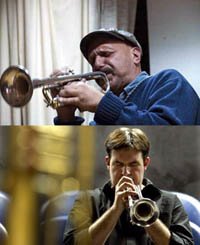
Things are happening very fast.
I went to hear Kris Tiner's Raphe Malik "tribute band" (that's sort of an inelegant way of describing it, alas) a few hours ago, and was suddenly overwhelmed. Both by the beautiful music, expertly played, and by the way it made me think, in a sort of macrocosmic way, about the task of leaving Los Angeles (which is becoming more of a "done deal" with each passing moment) -- not to mention the as-of-yet-unknown ramifications of said move.
Update: after much frustration trying to buy a home in the Bay area (how can anybody afford to live there?), we went back to plan A: Portland. Daphne secured "official permission" from Leila (her boss / friend) to the effect that since she (Daphne) is working from home anyway, it doesn't really matter where home is. Portland immediately beckoned, with its clean air, cheap housing, good food / coffee / friends, and small-scale funkiness. I have commemorated our intentions to make it our home with a tune entitled "PDX LIX LAX" (get it?).
Don't know about the Portland music scene, though. I mean, I'm sure there is something to it, but I wonder if LA has spoiled me. I also wonder how complicated it will be to keep the group alive from so many miles away -- cuz that's my plan at the moment, assuming we actually move. (With the money we'll be saving on cost-of-living expenses, I'm guessing that I'll be able to afford to fly down to LA for rehearsals / gigs / recordings once a month or so. Hey, I've been known to do crazier things.)
Daphne and I have been looking at homes a bit online, and the first day of that was a little trying: our realtor sent us a mess of stuff that seemed plucked straight from the moldy heart of suburban hell. Our memories of Portland were much more fun than that. Ms. Realtor got it right the second time, but the stink of the first batch really made me realize how much of a risk we're taking.
Then, tonight at the show, the positive residue of my time in LA manifested itself in the very rarest of ways -- a physical expression of respect and community. The show turned out to be a reunion of sorts: in Kris's group was Cory Wright, one of the almost-original members of the IJG, who had himself recently relocated to Berkeley. Aaron Kohen, one of the actual original members of the group, was there too -- not performing, but listening. As were other people I hadn't seen in a while, and still others I had seen just yesterday, at rehearsal.
I usually avoid socialization like the plague (hey, it's a quirk), but here I felt totally comfortable. I was conscious of the fact that I was among peers, friends, people I can actually relate to. I was also conscious (though not in a depressing way) that these relationships won't last forever, if for no other reason than that we all kick it someday (RIP, Raphe Malik). I wanted to savor the moment.
I have no intention of getting weepy about the last ten years. I have always felt at home amongst the musicians of this city, but most of the time that feeling is abstracted, or else hidden under the many layers of stress and work that attend every IJG event. This, on the other hand, was -- to paraphrase Milton -- "community made visible." It's a phenomenon that happens infrequently in my life, but when it does, it leaves a lasting impression.
Sometimes I can't believe how fucking lucky I am.
Sunday, July 30, 2006
The Puritan Broadcasting System?

What the fuck?
Apparently Melanie Martinez, the effervescent lil' host of the Good Night Show on PBS's Sprout cable channel, was fired.
(Actually, not apparently, but definitely. What it with me and adverbs these days?)
The cause of the firing is a series of harmless PSA spoofs MM did seven years ago. You can see them here and judge for yourself.
Ooo, lookit, she says the word "vibrator"!
Now, I was never a fan of the Good Night Show, except for the wacky Pingu the Penguin claymation stuff. But that's not the point. The point is that, really, what the fuck? PBS, are you a bunch of morons? Your programming has become insipid enough, now you're going to finish it off by purging it into a fine fascist inhuman goop? What's next? I suppose none of the people who work on any of your programs can ever talk about sex? Hmmm. Can they have impure thoughts every once in a while, perhaps in the comfort of their own bedroom?
Gooodddddaaaammmmmmitttt, what is happening to this country?!
Here's a link to a petition to get Ms. Martinez her job back. Don't think a list of names is gonna make a difference, but it's probably worth a try.
And here's a link to a kickass SF Chronicle article by Mark Morford. It analyzes the firing, and, well, kicks ass while doing so.
Wednesday, July 26, 2006
Trying not to melt
A brief respite from the heat. Don't know how long it will last, but I may as well type while doing so doesn't produce perspiration.
We haven't even been in the triple digits, as have our poor inland neighbors (aka suckers), but the lack of air conditioning, the unusually high humidity, and the fact that our apartment is hard to ventilate make things difficult. I've never been a fan of southern California attire, but I haven't worn long pants or proper shoes in two weeks.
It feels very much like Keith Olbermann put it last night on the Tonight Show (a program I rarely watch): Al Gore was wrong about global warming... we don't have ten years to fix the problem, we have ten minutes.
Everyone in our complex keeps their windows open. You kind of have to, because, as I said, there's no AC, and fans alone provide precious little relief. You've got to try and catch the ocean breezes where you can. But you also end up throwing all modesty, well, out the window. Just heard a couple fucking somewhere nearby. (You know it's hot when the only time you have the energy to do the deed is six AM.)
Anyway... remember our second album, the often mis-spelled City of Angles? It appears to have been re-entered into rotation as bumper music on NPR's Talk of the Nation. I noticed that they played "Void When Detached" last month, and Theme From City of Angles" just a few days ago.
What's next? IJG on the Prairie Home Companion?
We haven't even been in the triple digits, as have our poor inland neighbors (aka suckers), but the lack of air conditioning, the unusually high humidity, and the fact that our apartment is hard to ventilate make things difficult. I've never been a fan of southern California attire, but I haven't worn long pants or proper shoes in two weeks.
It feels very much like Keith Olbermann put it last night on the Tonight Show (a program I rarely watch): Al Gore was wrong about global warming... we don't have ten years to fix the problem, we have ten minutes.
Everyone in our complex keeps their windows open. You kind of have to, because, as I said, there's no AC, and fans alone provide precious little relief. You've got to try and catch the ocean breezes where you can. But you also end up throwing all modesty, well, out the window. Just heard a couple fucking somewhere nearby. (You know it's hot when the only time you have the energy to do the deed is six AM.)
Anyway... remember our second album, the often mis-spelled City of Angles? It appears to have been re-entered into rotation as bumper music on NPR's Talk of the Nation. I noticed that they played "Void When Detached" last month, and Theme From City of Angles" just a few days ago.
What's next? IJG on the Prairie Home Companion?
Friday, July 21, 2006

Violence
What a way to start off the 21st century, eh?
In case you don't feel like reading that article, I'll summarize it for you: everyone in Iraq is either killing somebody, being killed themselves, or about to enter one of those two categories.
I pass this information along as a public service announcement, in case you missed it during all this Lebanon business (easy enough to do).
Maybe you still think the war was a good idea? Why not go there and check it out for yourself? Prove me wrong. I'll wait here.
In case you don't feel like reading that article, I'll summarize it for you: everyone in Iraq is either killing somebody, being killed themselves, or about to enter one of those two categories.
I pass this information along as a public service announcement, in case you missed it during all this Lebanon business (easy enough to do).
Maybe you still think the war was a good idea? Why not go there and check it out for yourself? Prove me wrong. I'll wait here.
Subscribe to:
Posts (Atom)